|
|
|
|








|
If you don’t know where you’re going, any road will take you there.
Any road also works if your destination is "not here".
Obstacles are those frightful things you see when you take your eyes off your goal. Voting and Ballot Counting Goals
Why Change?
Insanity is doing the same thing over and over while expecting
different results.
Do we want to keep getting what we always got? If your answer is "yes", thanks for stopping by. If not, please keep reading. It shouldn't matter how many candidates are running or how votes split among like-minded candidates. With only 2 candidates, except in rare cases of a tie, one candidate wins with majority support which meets goal #1. What happens if there are more than two candidates? Could a candidate opposed by most voters win? Could two candidates be considered the "real" contenders with independent or other-party candidates considered "vote-stealing spoilers"? Could voters feel like a vote for one of the "other" candidates is wasted, or fear that the winner could be the candidate they want least? How do voter turnouts for runoff elections compare to turnouts in a general election? How much do runoff elections cost governments and candidates? If there were several candidates in the general election, could the two runoff candidates be extreme, polar opposites with no middle ground? How might voters feel about their voting choices? Is it possible that many voters might prefer a candidate who didn’t make it into the runoff? In multi-seat, at-large elections such as city councils, school boards, or county supervisors, should the largest interest group choose all the winners even if that group represents less than half the voters? Do negative campaigns or attack ads give voters the information they want and need to choose an effective representative? How Can Ranked Choice Voting (RCV), also known as Instant Runoff Voting (IRV), Help Meet the Goals?
Easy as 1-2-3
Runoff elections are about second choices. A general election asks "who is your preferred candidate?" A runoff election asks "If your first choice lost, who is your second choice?" RCV asks both questions in the same election: "who is your first choice?" and also "if your first choice loses, who is your second choice?" If there are more than 3 candidates, an RCV ballot could also ask for a third (or fourth or fifth) choice. That’s the "instant" part of "instant runoff". Think of ranked voting like rating each candidate. It’s also like prioritizing a to-do list, or having a backup plan when choosing a university, applying for a job, buying a home, or choosing an ice cream flavor. To help visualize the process, imagine that all voters and all candidates gather in one place.
Not ranking all the candidates is allowed but is like going home before the election is over. Each voter gets one vote in every round and all votes count equally. The vote-counting computer follows a procedure similar to the visualization above.
Benefits of Ranked Choice Voting (RCV)
Voting for Just One is So Much EasierYou can still vote for just your first choice if you wish. Those who prefer to express their thoughts about some or all of the candidates have that additional power. The first time I voted using ranked choice voting, it seemed daunting. I only knew some of the candidates. As I learned about all the candidates, I realized I had preferences. I decided on a "divide and conquer" approach. I first divided the candidates into three groups: most preferred, acceptable, and less preferred. You may choose different groups, or a different number of groups. Now there were only a few candidates in each group, and it was easy to assign rankings within the group. Giving More Voters a Voice in Single-Winner Elections
Another Way to Tabulate Ranked Ballots
A tabulating procedure known Condorcet uses the same ranked ballots but tabulates them differently. Rather than calculate a series of runoff rounds with one candidate eliminated each round, Condorcet calculates a series of one-on-one elections pitting each candidate against every other candidate, one at a time. The winner is the candidate who beats all others. In each round, the computer checks each ballot for the two candidates in the current contest and chooses the highest-ranked candidate of the two as that voter’s choice. See the sample election below. The two candidates considered in a round might be the first and second choices on one voter’s ballot, and the third and fifth choices on another voter’s ballot.
Advantages of Condorcet
Condorcet gives voters in a minority party or interest group a greater say in which candidate wins from the majority party or interest group. This can lead to winners closer to the center which could help depolarize districts where an extreme majority party or interest group has a lock on the outcome and minority parties or interest groups are marginalized. 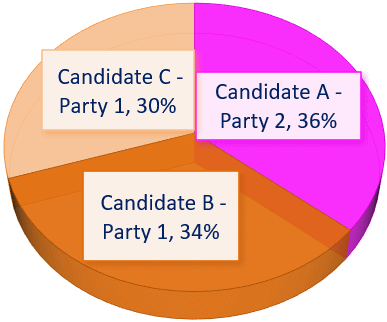
The above diagram shows a very close race with Party 1 candidates B and C combined having a 64% majority so we would expect a winner from Party 1. Using first-past-the-post vote tallying in which the candidate with the most votes wins, candidate A of Party 2 wins as their candidate has more votes than either candidate from Party 1. This violates Goal #1. Using a traditional runoff between candidates A and B denies Party 2 voters the opportunity to express a preference for candidate C over candidate B. Using RCV rules, Candidate C of Party 1 would be eliminated as this candidate has the fewest votes. Assuming those who selected Candidate C as their first choice remain loyal to their party, most of the their second-choice votes would go to Candidate B of Party 1 making Candidate B the winner. Even though Candidate B wins and will represent all voters, Party 2 voters had no say in which candidate of Party 1 represents them. Party 2 voters could select a Party 1 candidate as their first choice, but that violates Goal #2. It is also possible that many Party 1 voters are upset with both Party 1 candidates and might prefer the Party 2 candidate. The voting system should be flexible enough to support all possibilities. Using Condorcet vote tallying, and assuming most Party 1 voters remain loyal to their party, both Party 1 candidates would beat the Party 2 candidate. The contest between the two Party 1 candidates now depends on the second-choice votes of Party 2 voters. Party 2 voters would likely choose the Party 1 candidate who is closer to the center. If most Party 2 voters prefer Party 1 Candidate C then Candidate C would win and represent all voters in both parties.
Disadvantages of Condorcet
Ranked Voting Paves the Way to Proportional Representation
If you are not at the table, you are on the menu.
Proportional representation is a fancy way of saying majority control with minority representation. Why encourage minority representation if you’re in the majority? Because there may come a day when you’re in the minority. Also to help meet Goal #1, to help guard against a complacent majority making quick decisions that could have unintended consequences, and to have a government that understands the needs of most citizens. A majority group of voters elects at least three members of a 5-member city council, but minority groups also get some representation by electing the remaining council members. The five council members together represent nearly all voters. To help visualize this one, imagine all voters and candidates gathering in one place to elect five city council members.
Why set the minimum votes to win at 1/6 rather than 1/5 for 5 seats? If one candidate gets over 1/5 of the votes, there are less than 4/5s left, not enough to elect 4 more winners. If the threshold is less than 1/6, there are enough votes to elect more than 5 winners. When the 5 winners collectively get over 5/6s of the votes, there aren’t enough votes left to elect another winner. This achieves the goal of minority representation since any voter group including over 1/6 of the voters elects at least one council member, and the 5-member council represents over 5/6 of the voters. All the losers together got less than 1/6 of the total vote. Another goal is majority control. That’s why we close any line with just over 1/6 of the voters. If over 2/3 of the voters have the same first-choice candidate, that candidate wins easily. We expect a group including over 2/3 of the voters to elect four of the five council members since 2/3 is the same as 4/6, four times the 1/6 needed to win. A candidate with over 4/6 of the vote got 3/6 more than required to win. That extra 3/6 could elect three more candidates each meeting the 1/6 minimum and provide the 4 winners we expect from a 2/3 majority. The winner keeps the 1/6 minimum needed to win, and the extra 3/6 moves to the voters’ next-choice candidates. Casting ballots is like other ranked voting elections: Rank the candidates in order of preference. The vote-counting computer really earns its electrons with this one. Proportional Representation Makes Gerrymandering IrrelevantWhen using RCV and proportional representation, it does not matter how districts are drawn because the system itself enforces representation of minority interests. Even if a minority-only district could be drawn, minorites would elect all the representatives from their district, and would still get some representation in other districts. Minority representation in a governing body consisting of multiple districts would still have the same number of minority representatives. Gerrymandering would only determine how minority representatives are distributed among districts.Is Ranked Choice Voting for Real?The links page has more about how ranked voting works and details about how and where it is used now. |